Search This Blog

A Bit More

Saturday, April 03, 2010

ENJOY FLORIDA'S EVERGLADES AT LOXAHATCHEE

Good day in Florida at the Arthur R. Marshall Loxahatchee Wildlife Refuge at the northernmost tip of Florida's Everglades. It's a place to learn about the Everglades and to get an idea of how we are trying to save what is left. It is also a place to get a peek at the variety of species that grow, live, and pass through this environment—unique not only in our country but also in the world.

Rob and I begin, as always, looking for background in the visitor center, a small place packed with information about what we might see as we walk the trails. The refuge is 143,874 acres or 221 square miles, so there is a lot to learn. We see a film describing the Everglade's special qualities and detailing the history of Florida's agricultural and residential development that, without intervention, would have totally destroyed this ecological gem.

We also take a virtual airboat ride through the Everglades, viewing some of the animals and birds that live here as well as some of the astonishing features such as tree islands made of peat that float to the surface and give a place for seeds to sprout into grasses or trees.

Out in the open air, we walk the mile path through the Cypress Swamp, dazzled by the tall, tall cypress trees, the hanging moss, the cypress “knees,” the different lichens on the trees, and the other features described on signs as we follow the boardwalk.
Loxahatchee, Florida
We hear the lovely voices of many birds, but they are incredibly well camouflaged, and they are not likely to display themselves for the folks. The boardwalk is inches above what appear to be still, clear waters. The flow of water through the Everglades is virtually imperceptible. Visitors walk very slowly and very quietly in the Cypress swamp. The appearance is chapel-like, but the reality is that we all hope to see some of the animals that make this ecosystem their home. Regardless, the atmosphere is lovely.

After this walk we drive to the levees and the canals that lead into a different section of the Everglades. We're at the sawgrass edges, a sedge border of sharp grasses named for their characteristics. In the more open spaces are lilies, and from the overlooks we can see fish, turtles, different water fowl, dragon flies, and many, many things I can't begin to identify. I, of course, am looking for alligators, but I am not rewarded. I feel as if I am back in Alaska futilely looking for moose! The warning signs for alligators are clear. If they associate humans with food, they will come over, and if they don't get fed, they will become consistently aggressive, and they will have to be killed. 'Nuff said.

This section of the Refuge is obviously highly managed and does not look at all as I imagined. However, there is a five mile canoe trail through the Everglades, and there are rentals at the entrance. There are also areas for fishing, and in the parking lot are quite a few empty boat trailers. The fishermen, for the most part, are somewhere deeper and beyond our vision. I'd like to do that.
Loxahatchee, FL

Major sections of the Refuge are not open to the public. This majestic refuge is an indispensable buffer against the development surrounding it. Careful and diligent stewardship of this area is definitely in our national interest. We should be aware of it and its value today and to future generations. We should continue to make sure the government funds and supports it.

We are also planning to enter the Everglades at another point, the National Park site, and we expect that visit to be even more of an experience—just as we’ve found at other National Parks.
If anyone has trouble walking, the trail visitor center, the trail through the Cypress Swamp and the lookouts and trails along the levees are all handicap accessible. No one should miss this.

Technorati Tags:
, , , , , , , , , , , , , , , , , , , , , , ,

Monday, March 29, 2010

BACK TO ALASKA AND COLLEGE--COLLEGE FJORD, THAT IS

Trust me, it’s not in my retirement schedule to be anywhere at 6:30 AM, but that is the time we reached College Fjord and the incredible sights awaiting us, so we were on the top deck, warmly dressed and ready. Did I say things could not get any better on the Alaska trip? It is time to get up close and personal with a glacier!!

Named College Fjord because the glaciers are named for colleges, we go up to the highest deck to see the Harvard Glacier. Once again we enter a strange, cold, and magnificently beautiful world. These huge masses of ice full of power and grace flow and create this great bay on which our cruise ship, The Coral Princess, is small and insignificant in size or strength. From our vantage point, we can actually observe the glacier calving. We are constantly reminded of Nature’s monumental power and beauty.

As we near the glacier, we see the colors in the ice and the dark lines of silt lifted from the earth and carried with the force of the glacier’s relentless movement. Even in this early morning light, nature is seen as unforgiving and harsh.

Try to see yourself there….

I share the misty pictures of one glacier from different distances. Rob and I stayed on that top deck until The Coral Princess sailed from Glacier Bay. Could it get better and more dramatic? We still had a visit to the Inner Passage to think about.


College Fjord
Harvard Glacier


HARVARD GLACIER


College Fjord

Glacier

College Fjord

Wednesday, March 17, 2010

WE HEAD TO FLORIDA FOR WARMTH. HUH???

181 South Ocean Ave.
West Palm Beach, FL 33404
(561) 836-4000

Back at Palm Beach Shores Resort and Spa for the third time, I feel as if we are coming home. Our stay this year, from February 21 through March 7, becomes two weeks of below normal temperatures. Not the vacation in the sun I know and love. The temperatures put a definite kink in plans to luxuriate on the sands, but we are away from those miserable northeast snowstorms, so this is the place to be.

We come here on a time share trade. Walk in off the street or book through Travelocity and this hotel will cost in the neighborhood of $325.00 per night. Our one bedroom suite is immaculate, totally stocked to make our stay easy and very comfortable. From our balcony we have a beautiful view of the heated pool and, more importantly, the ocean which this year, unfortunately, is colder than the air temperature. The ocean isn't tempting, but watching it and hearing the surf pound the shore is sooo relaxing and soothing. The pool is heated, the spa is at 104ยบ which is the temperature we keep ours at home, and the beach just a short, inviting walk across the sand dunes. On the beach we can rent a wind screen or umbrella if we wish. There’s food and bar service, and that works out well. On three days during our stay Rob and I did spend time on the beach, but this photo was taken on a day I bailed out and, in a rare moment for us, left Rob to soak the rays (freeze) on his own. I did try to persevere but when I had to wrap up my toes.... At Palm Beach Shores, for timeshares at least, towels are changed daily, supplies are replenished, and trash is removed, but only once during the week is there complete housekeeping. If that is a concern, for an extra fee one can have complete housekeeping services, but frankly, I can make my own bed without any adverse reactions. Palm Beach Shores Resort is a Gold Crown Resort, the highest ranking in the timeshare resort world, and it is because of the amenities and because it is right on the beach. That is our main requirement. This is far from some of the luxurious resorts in which we've stayed, but it suits us just fine, and we will be back again. This is no place like home where the beach and the ocean are a long car ride away.
Another extra special aspect of this hotel is the staff. The staff is efficient, friendly, and an absolute pleasure. That has been true each time we've stayed here, so I know it's not an aberration. They aim to please, and they will react quickly to requests, make very good suggestions, and offer ways to make our stay enjoyable. Last time we were here, for instance, I forgot my bathing suits when we left for home. I realized it when we reached Orlando for a three-day stop at Epcot/Disneyland. I called, and by the time we got home four days later, the package with my suits was waiting for me.

With the weather as cool as it has been, it was particularly heartwarming that the one night when a freeze was forecast, notes were slipped under the doors reminding us to draw the drapes to hold in the heat and also reminding us of extra blankets in the closet. That's just one example of the little extra thought shown here. I like that.

Certainly I'm not in favor of the daily parking fee; on the other hand there is valet parking. I don't like the daily in-room safe fee either. But I love the free internet in the room—either wireless or cable. There is also wifi in the lounges downstairs. They have a very good restaurant, the Islander Grill and Tiki Bar with daily specials. There's a happy hour, live music around the pool, two movie nights, and daily walks and activities if one chooses to participate. The exercise room is also nice, but Singer Island is a wonderful area to walk—if it's not too cold. The John D. MacArthur Beach State Park is close by, and there are wonderful walking trails there too. Each year we intend to ride bikes, but we haven't yet. Maybe next year.

If you're a time share owner who trades through RCI, think of Palm Beach Shores Resort and Spa, or if you're looking for a nice, suite hotel on Singer Island, Florida, think of Palm Beach Resort and Spa. But please make sure you leave two weeks for us! Look in Third Age Traveler labels under Florida for some good restaurant suggestions and our reviews of the auto-train which we took one-way this year.

Technorati Tags:
, , , , , , , , , , , , , , , , , , , , ,

Thursday, February 25, 2010

THE RIDE TO VALDEZ--AND BEYOND

J.J. slips Willie Nelson's "On the Road Again" into the system and eases his way down the road away from Copper Canyon Princess Wilderness Lodge. I say eases because that's how the coach moves down the steep, serpentine road. No wonder this place will be closed for the winter in just a week or two.

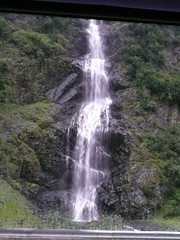
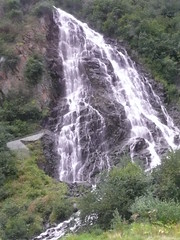
The ride to Valdez winds through the Chugash Mountains. Because of their proximity to the coast, the the Chugash Mountain Crest is the snowiest place in the world with an average annual snowfall of over 600 inches. We travel the Richardson Highway built in the mid 1940s. Prior to that time, the way to move from the coast inland was over the “Goat Trail” which wound through the mountains. Today what is left of that wilderness trail can be be recreationally hiked. It's another world since the 1940s. Hikers can pick up the Goat Trail off the highway at Bridal and Horsetail Falls.

J.J quickly points out Mt. Billy Mitchell (named after Billy Mitchell, father of the modern Air Force and the man who correctly felt that control of the North American continent would be done by those who held Alaska, a point proven during WWII).

We also pass the beautiful Worthington Glacier and once again see Nature's palette at work.


One marvel follows another, and coming over the Thompson Pass, rising up through the clouds and coming down through the clouds is breathtaking. Thompson Pass rises to 2,678 feet and can get as much of 980 inches of snow. Those poles are not mere light poles. They indicate to the snow plowers the depth of the snow and also show them the road. Imagine the snow like that! This is not a road one wants to slip off! I'd bet that through most of the lower 48, a sign reading Easy Freeze means ice cream. Not in Alaska! Nothing like Flash Freezing FISH!!!! Ha Ha Ha It is a bit sad to get to Valdez. It's the end of the land part of our tour. Though it's been spectacular, we also know we've barely scratched the Alaskan surface. In fact, we've been advised that when we return, we should make sure to get to Nome. It's an entirely different world.

Valdez is very small, and in the mountains across the water we see the huge oil tanks. Valdez is 96% recovered from the 1989 Exxon Valdez Oil Spill. We've no time to explore, however, as we board our catamaran for the speedy trip down the Prince William Sound to Whittier where we'll meet the Coral Princess. Our catamaran is quite a boat. It has real-time sonar and map, and it's fascinating to follow our progress, to observe icebergs, perhaps results of Columbia Glacier's calving, and spot those seals resting on a buoy. We see fishing boats on the Sound. Silver salmon are starting to run. Fishermen cast their gill nets and bring their catch to the tenders that bring the fish back to port.

(NOTICE THE SIZE OF THE BOAT COMPARED TO THE "LITTLE" ICEBERGS)
It's a difficult but very important way of life they lead. This life was violently interrupted in 1964 by the Good Friday Earthquake. Valdez was the city closest to the epicenter, and the earth rose and fell about three feet. Prince William Sound emptied and came back as tsunamis that virtually destroyed Valdez and left 32 people dead. It is one more place that proves Alaska is not an easy place.

Technorati Tags:
, , , , , , , , , , , , , , , , , , , , , , , , , , , , , ,

Thursday, February 18, 2010

NATURE AT COPPER RIVER, ALASKA

Sitting out back of the Copper River Princess Wilderness Lodge, we overlook America’s largest National Park, Wrangell-St. Elias, equal in size to six Yellowstones! Our stop here at Copper Center reveals another kind of Alaska, so independent that until recently there was no local government.

This National Park is primarily primitive, so Rob and I take a tour with another Alaskan transplanted from the lower 48. This naturalist, Dave, as other transplants we've met, has a “background.” Dave is a retired teacher who came to Alaska in 1978 and has spent the last 19 winters here. In this area people live in log cabins or simple houses and many do subsistence hunting. Dave explained there is a tiny but very expensive, grocery store about four miles from his house. When he and his wife get to Anchorage to see a doctor or to run other essential errands, a 4½ hour drive each way, they stock up with as much as their truck can carry. Dave is also the founder of WISE, the Wrangell Institute for Science and the Environment, a non-profit group whose mission is to provide science and environmental education and to instill stewardship. Dave’s love of Alaska is practically palpable, and our four hours with him is educational, fascinating, and one more highlight of this trip. Dave gives us a wonderful tour of the area. We move, once again, to another world. The watercolor landscapes of Denali and the shrubs and bushes along the Denali Highway give way to spruces, aspens, and other taller, thin trees. There are ten species of trees in this area of the state among which are black and white spruce, cottonwood aspen, birch, balsam, and poplar. A temperature of forty below zero is the cutoff for growing even though the area does get about ten inches of rain yearly. Only the hardiest varieties grow here. Trees grow slowly. While they may appear young by their sizes, many are quite old.

The temperatures of -40° and -50ยบ also make lakes like the expansive and beautiful Willow Lake unable to support fish. Fish simply cannot survive these winters. These are not facts that lure me to pack up and move, I can assure you. But there is a growing population in this part of the state, and that is the cause for beginning local governmental authorities.
We travel in a mini-van, and with Dave we are able to get up close to the Alaska Pipeline. Rob and I know people who came up here to work on the pipeline. The best part of our time with Dave is spent on the two trails we walk. He shows us different ecological systems and explains how they work. We see the important work of beavers, learn about permafrost and come to understand the lack of variety in tree species. The trails we follow help us solve that age old question, Does a bear…..We walk along ridges overlooking the Copper River Valley where once again we are treated to jaw-dropping views. In a tent reminiscent of our Girl Scout platform tents, Dave has a trail-side museum with artifacts illustrating the many things we’d learned during our time with him. Some kits show us the skulls of animals in the area, and he has skins, donated, which are fun to touch and in the case of a grizzly bear, to try on. He emphasizes, as did our guide in Denali, the inter-relationships that exist in nature. Right now, for instance, the snowshoe hare population is declining. They are food for the lynx. What will happen to the lynx? The Denali guide indicated that this is cyclical and that nature adjusts. The hare will return and then the lynx will too. Amazing to me is Dave’s presentation of the mandible of a moose. (not the above photo) It is so heavy I cannot pick it up with one hand. He explains how in nature every part of an animal is utilized. The rodents, for instance, eat the moose antlers as a source of calcium.

As we continued on the trail, we taste some of the mainstays of the local diet—both human and animal: lingonberry and pumpkinberry, for instance.

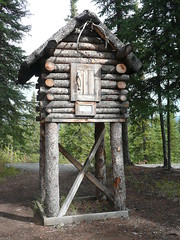
Later in the afternoon, Rob and I take a walk through the woods along the marked North Trail at the Lodge. Along the trail we are treated to an incredible variety of mushrooms, and near the lodge to strikingly vividly painted flowers. No matter where we are in Alaska, the beauty is overwhelming. We also get to see a food cache up close. Remember that the legs of these caches are greased up to prevent climbing animals from getting in.
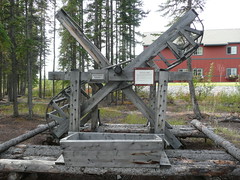
We also see a fish wheel, an interesting and efficient way for the Native Alaskans to fish.

How enlightening is this trip! I’ve absolutely no complaints. For more information about WISE, the Wrangell Institute for Science and Environment, please go to www.wise-edu.org, or contact@wise-edu.org.

Technorati Tags:
, , , , , , , , , , , , , , , , , , , , , , , , , ,