Search This Blog

A Bit More

Showing posts with label Nevada. Show all posts

Saturday, May 10, 2014

MORE TO NEVADA THAN LAS VEGAS; GO TO THE HOOVER DAM

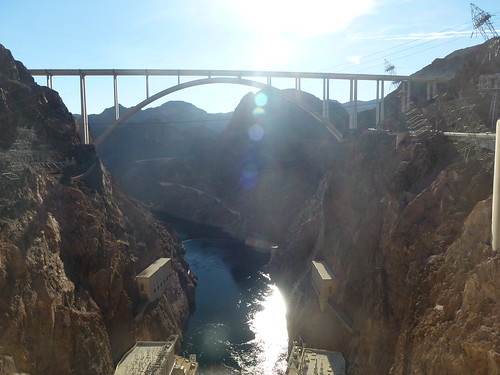
Hoover Dam
The Hoover Dam straddles the Nevada-Arizona border
Every couple of years Rob and I go out to Las Vegas.  The first time was way back in 1971 when we arrived after driving through Death Valley in our very hot, unair-conditioned VW beetle convertible, took a free motel room offered if we sat through a “real estate presentation,” and woke up to see what was then “The Strip” out the front window and nothing but desert out the back. 

Times and Las Vegas have certainly changed, but we haven’t.  While we are still not gamblers, we’ve succumbed to Las Vegas’ fascinating allure.  But I digress. 

This post is really about Las Vegas as a gateway to the fascinating Hoover Dam, a place that has been on our hit list but which we somehow never managed to visit—until this trip.
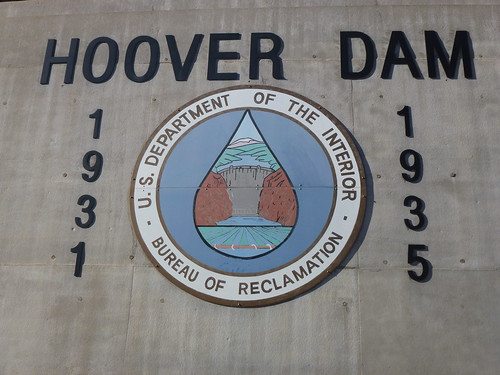
Hoover Dam
Take note of the years
The Hoover Dam is an American icon, famous and visited by more than seven million people a year.  It provides water to arid and semi-arid sections of our country.  Its construction enabled farming to flourish in the southwest.  It was the largest and tallest dam at the time it was built, and even today it is the largest concrete dam in the western hemisphere.  It is remarkable.  It is beautiful and graceful.  If you have the opportunity to visit, take the tour and make sure you allow enough time to walk the span and view it and the Colorado River from all angles.  You will gawk in amazement.

Hoover Dam
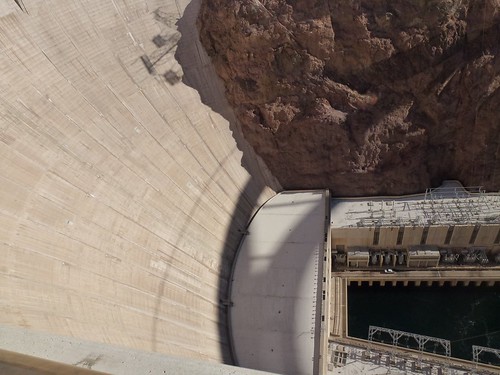
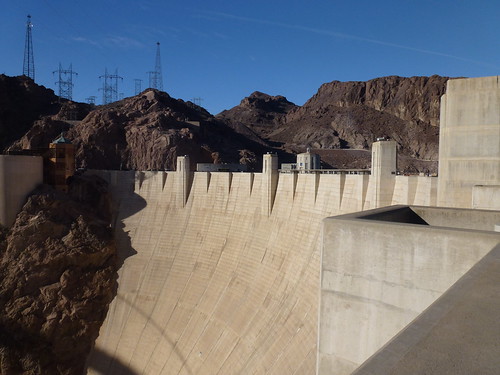
The dam is 726 feet high
It is 1244 feet long
At the top it is 45 feet thick
Hoover Dam
Look down from the top, and you will gasp just a bit.
If you imagine the constant sound of rushing water thundering through the canyon and being held back and released—a thunderous sound anyone who has visited Niagara Falls would recognize—don’t. The Colorado’s power is released inside this massive structure, water brought in through an intake system, and gently released after being used to send hydroelectric power out to the country. 

Hoover Dam
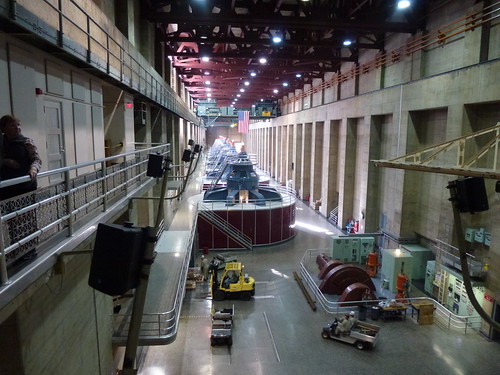
Does this "room" which houses the turbines look small
as you watch from above?
Hoover Dam
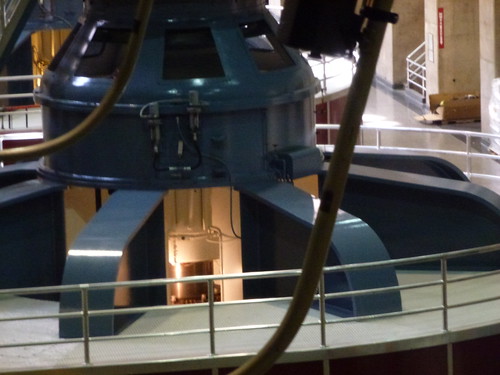
Here is a little bit of a close-up.  These are HUGE.
With all the “modern miracles” to which we are exposed daily through the media, it is sometimes easy to forget that real miracles do happen, and the Hoover Dam might be considered one of them.

Imagine the political upheaval.  The mighty Colorado runs through seven western states into Mexico, and each state has its own priorities and problems.  Within each state are two factions: urban and rural.  Each faction has its own priorities and problems.  Before anything can be done, the federal government has to improve and furnish funds.  There is also the conflict between money intended solely for the west without consideration of the eastern part of the country.  Political progress is snail-crawling slow.   It takes years before Herbert Hoover, well before his presidency, can negotiate the Colorado River Compact to make the dam a possibility.
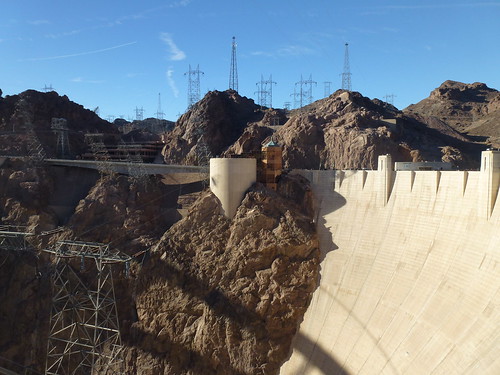
Hoover Dam
Hydroelectric energy sent out to power the states.

More than 200 engineers helped design the dam that was first proposed in 1922 and approved through the Boulder Canyon Project Act in 1928.  By that time it was Herbert Hoover, president, who signed the Act into law.

Imagine the workforce problems.  The site, Black Canyon, straddling the Arizona, Nevada border, is in the middle of a desert.  Yet men and their families, ailing from the early part of the depression, heard about the job possibilities and ventured lock, stock, and barrel out to the blistering desert where there was no housing or facilities ready for them, only the hope that there was a job. Many lived in tents.  Some did not have even that.  Work did not begin until a year after word of the project went out, but the men wanted to work, and they camped out and suffered until construction commenced in 1930.  Sometimes the temperatures rose to a blistering 130°.

Over 21,000 men worked on the dam, about 5,000 at any given time, in three shifts a day round the clock.  Men worked seven days a week, fired if they refused.  Two days off a year, Christmas and July 4th, optional and without pay.  It is estimated that 107 men lost their lives on the project which was miraculously finished in record time.  There were work-related issues, a strike, oftentimes a carelessness toward worker safety and health, but most issues were cast aside to complete the project. 
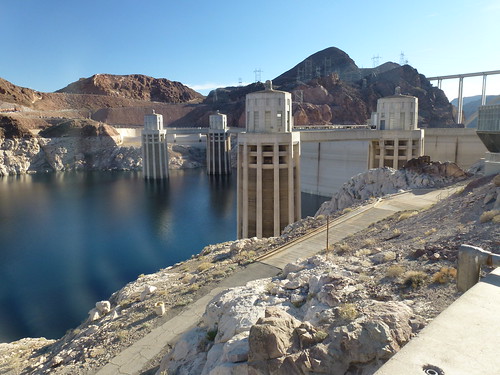
Hoover Dam
After serving its purpose, the water is released on the other
side of the dam.
Imagine this miracle: the Colorado River was diverted on Nov. 14, 1932 and the last concrete was poured on May 29, 1935.  President Franklin D. Roosevelt dedicated it (then known as the Boulder Dam) on Sept. 30, 1935.  The time span is a miracle!  Just think of public works’ progress in your area today!

And public works the Hoover Dam was.  This was man’s attempt to harness a wild, untamed river, the Grand Canyon carver—the mighty Colorado River.  Harness its power and floods plaguing one section might be stopped and allow agriculture to flourish.  Harness its power and the desert could be watered into cooperation with agriculture and human life. 

Had the dam been built by pouring concrete the conventional way, the concrete would have taken 125 years to cure.  New techniques had to be  developed.  There are a host of engineering and architectural developments as by-products of the dam’s construction.

When the gracefully arched dam was finished and the water poured in to the area beyond, Lake Mead was formed—115 miles long and 500 feet deep.  This is in the middle of the desert! 
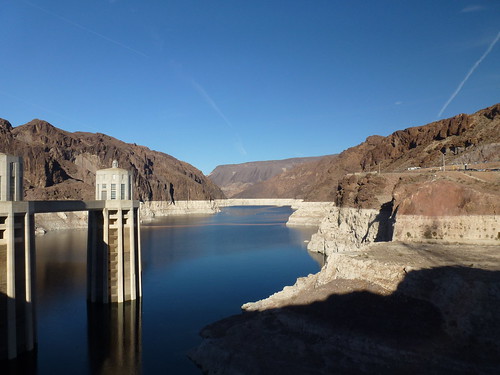
Hoover Dam
Notice the white "border."
Only once in its history were the spillways opened.  That was in 1980.
The water level was so high that it left its watermark as it receded.
I think it adds even more beauty to the scene.  Don't you agree?
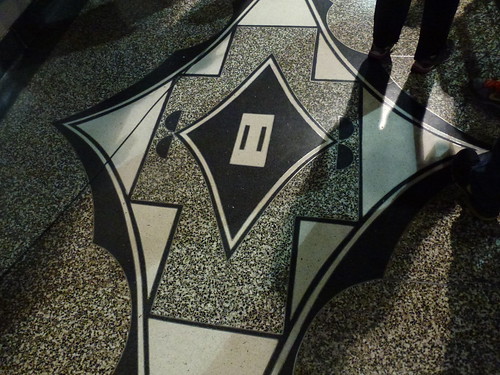
The Hoover Dam is also beautiful.  Its design is futuristic in an art deco style.  In the engine room where 17 turbines generate two billion watts of electricity, the floors are terrazzo marble in designs reminiscent of Native American patterns. The dam is magnificent, inside and out. There is even a celestial map marking the exact position of the stars on the day President Roosevelt dedicated the dam.
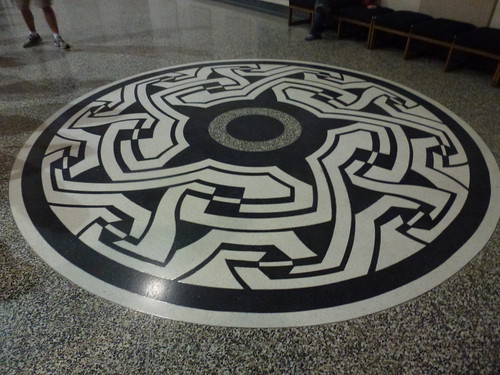
Hoover Dam
Priceless by today's standards.
Impossible to use terrazzo marble today.
Hoover Dam
You can also see how huge these designs are.
Quite magnificent.
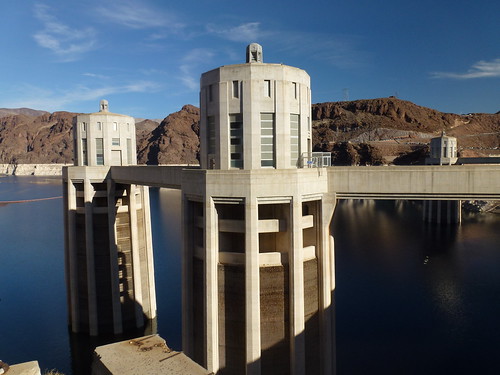
Here is a sad and interesting fact culled from a PBS special on the dam.  On Dec. 20, 1935, a worker, Patrick Tierney fell from an intake tower and drowned.  He was the last man to die on the project.  He died 13 years to the day that the first man died—J.G. Tierney, his father, a surveyor who fell from a boat and drowned.

Hoover Dam
Beautiful
Las Vegas is grand, but the Hoover Dam is grander.  Don’t miss it.  Pause to consider who this wonder was created.  Your jaw will drop in awe.


Friday, November 06, 2009

ALASKA NATIVE HERITAGE CENTER--A MUSEUM NOT TO BE MISSED

RAVEN THE CREATOR

Although the clouds blanketed the Chugash Mountains, we were prepared for the rain. Taking the free shuttle out to the Alaska Native Heritage Center, we found one of the best museums of this kind we’ve ever seen. Staffed by young people, some still in high school and others in college, the museum is alive with history and culture, and we learned of an Alaska no one ever showed us in school.

The building was an eye opener. There are eleven or twelve recognized tribes, but because of geographical isolation, about twenty languages are spoken, and the differences often make it impossible for the tribes to communicate with one another. Because Alaska is so huge and so varied, the tribes survive in different ways. Some live solely by the sea, others are farmers, others are hunters and fishermen. This is definitely NOT a one size fits all state.

Outside the main building is Lake Tiulana, around which there are replicas of the different living quarters of the five predominant cultures. While we are in a museum, much of what we see still exists as tribes maintain their ways of life, particularly in some of the remote and challenging regions of the state. It’s also true that modern conveniences have been incorporated; some dog sleds have been replaced by snow machines, and modern communication systems are used when possible. However, values, and proven methods of existence continue unchanged. Guides answer our questions about the way each tribe lives, and it’s particularly interesting to see how the native Alaskans hunker down for the long winter—not only in their preparation for physical survival but also for social survival through music, dance, story telling, etc. Picture a long winter in tight quarters….

The young dancers in the videos explained that because space in the winter quarters is limited, too much foot movement is difficult, so tribes developed “hand dancing.” Hand movements had meaning, and we learned some movements so we could follow the story of the dance. These dances are still created, often about more modern themes.

Today there are native games—competition in the athletics of the tribes and limited to those who are native Alaskans. You’ll see the skill, strength and balance required by these young athletes in the video. Notice in the photo that she is balanced on one hand while she reaches overhead to the ball. You can also imagine the practical aspects of maintaining strength and agility as a necessity for survival.
Click to play this Smilebox slideshow: Native dances & sports
Create your own slideshow - Powered by Smilebox
Make a Smilebox slideshow


Rob and I had lunch at the center. First a wonderful chowder brimming with salmon, lobster, potatoes and other vegetables. Then we had caribou stew—a rich, dark, tender stew with meat leaner than beef. Excellent. We’re not going to get that kind of food in the lower 48.

There is a concerted effort to make native Alaskan culture accessible to all. There is a move, as well, to inculcate the culture into the young people. They study and learn here, and they are able to learn at the universities. There is an effort to develop a written language to preserve the cultures, but it is an exceedingly challenging effort. The Native Heritage Center, therefore, plays an important part in preserving as well as in educating everyone who enters. For us it was a thoroughly enriching experience.

Technorati Tags:
, , , , , , , , , , , , ,

Monday, June 30, 2008

I'M BETTING ON A GREAT LAS VEGAS WEEKEND--Part I

A long weekend in Las Vegas to attend the wedding of our friend Heather means a great catch-up time—not only with our son, Michael on leave from Iraq and our wonderful daughter-in-law, Leslie, and a large part of Heather’s clan—but also for Rob and me who seem to show up in Vegas about every twenty years! This is our third visit, so we get to see Vegas’ third reincarnation!!

Rob and I visited Las Vegas twice before: In 1971 (yes, ancient history) after driving our VW convertible (top up) through Death Valley. It was dark when we pulled into a motel (yes, aren’t motels ancient history?). In the morning we looked out our back window and saw nothing but desert. There was a road in front, the forerunner of the strip, and lots of signs advertising land for sale! If only....

The second time was in 1988 for the PMA convention, and this Las Vegas was the era of Caesar's Place, the Flamingo, the Tropicana, the Sahara and the famous personalities and revues. Hotels abounded, and there was a lot of action. Las Vegas had grown into a city, and we were amazed. But what seemed grand in ‘88 is inconsequential now.

Though we've heard of today's Las Vegas, nothing prepares us for the flight in. Through the plane’s windows we see far-reaching neighborhoods stretching out into the desert. We enter a different and amazing world. Some of the 1988 hotels are still there, but they are dwarfed by the hotels in this reinvented city.

We are staying in the MGM Grand, and on the main floor among the zillion slot machines, gaming tables, restaurants, and shops is Lion Habitat. Wow! Supposedly the lions featured in this free exhibit are direct descendants of the original MGM lion, Metro. These lions roam in a glass habitat built so we can walk around it on one level to see the lions and walk under it on another level to get a different perspective. Through the glass we can get very close. The lions are unperturbed.

The two trainers, who work six-day weeks to maximize their up-close time with the animals, are right in the cage with the lions, becoming part of the pride. This relationship allows special interaction I’ve never seen before. The lions rub their faces against the trainers’, showing affection and saying hello. It’s amazing to see. Rob and I spent a lot a time at Lion Habitat; it is impossible to simply walk through and walk away. It's fascinating to see the interaction between man and beast. You have to see it to believe it.

The MGM Grand is humungous. I cannot begin to estimate the size of the hotel, but it is monstrous and spread out in such a way that we can spend an entire day moving through the casino, the restaurants, the shops, theaters, clubs, and exhibits. We drop into the Stage Deli for lunch--yes, an offshoot of New York's famous deli. That's why we selected it for lunch. Around us are TV screens featuring basketball’s March madness, and there's not only gambling going on but also partisanship and applauding and hooting when favored teams score. The hotel is a playground, and it's a lot of fun! Rob and I aren’t really the kind of guests Las Vegas craves. There was so much to see and do that we only hit the casino once.

Back in New York we'd ordered tickets to Blue Man Group through the MGM’s concierge, but to exchange our vouchers, we have to head up to the theater located in the Venetian Hotel. We’re told the earlier we show, the better the seats. The Venetian Hotel is on our Must See list anyway, so this is not a problem.

The Venetian is phenomenal. It brings the outside world inside but only after we’ve walked through the inside world. Sound confusing? It is. But it is so fantastic, it is almost beyond belief.

We enter to blinding gold everywhere--painted ceilings, sculptures, and an incredibly long corridor. We pick up our Blue Man Group tickets and head down the corridor, through the casino, up the escalators, through the Grand Canal Shoppes, and into Venice. Here the outdoors are indoors. Here is the Grand Canal with gondolas and singing gondoliers. Here is St. Mark's Square with performance artists, musicians, restaurants and shops--even Murano glass is sold here. It's astounding. Like everything in Vegas, it is so huge it is difficult to comprehend. It is smile evoking. We do pass on the gondola ride at $15.00 per, but we take photos, and these I share with you. Remember, this is all inside the hotel!

Rob and I dine in Noodle Asian--delicious! Then to The Coffee Bean and Tea Leaf Too for some coffee, and we're there when Michael and Leslie call because they’re trying to find us before the show. They never do find us; the place is too huge and confusing, and we don't meet them until after the show. The theater, by the way, dwarfs any Broadway house. As with everything else, it is super sized. In addition to Blue Man Group, there are Phantom of the Opera, Jersey Boys, a comedy show and a joint exhibition of the Guggenheim Museum and the Hermitage of Modern Masters as possibilities in the Venetian Hotel. All in individual theaters or showcases, and I've not included any of the clubs or restaurants in this list. It boggles the mind!

Blue Man Group is beyond description. I think you have to be a slightly demented genius to think up the various marvelous routines, but this is one of the most original and wonderful theatrical events I've ever attended. I am soooo glad Spamalot (our original choice) was sold out! Even the audience participants are good sports, easing right into the spirit of the evening. The first three rows of audience wear plastic rain gear, and there is a good reason for that with paint splattering all over. The entire audience participates, decorating ourselves with rolled paper and reading our cues on the moving LED board. Spectacle is the order of the performance, and the technical virtuosity of the creators makes this an evening to remember. If you have a chance to see Blue Man Group, don't pass up the opportunity.

Needless to say, by the time the show is over we are really wiped out--the three hour time difference, the excitement, etc., but at 7 the following morning we are up to meet some friends--the bride's mother, aunt, and cousin for a two-hour coffee, fruit and yogurt breakfast at Starbucks. Then off we go to explore separately and rendezvous at Jimmy Buffet's Margaritaville at 4 PM. It's a great day to explore Las Vegas without being rushed because we’ll be back; this grown-up playground is a place we will re-visit, and not after another 20 years!


Tuesday, June 24, 2008

I'M BETTING ON A LONG WEEKEND IN LAS VEGAS--PART 2

I've come prepared with a list of the Top 17 Attractions as provided by Frommer’s, Fodor’s, www.schmap.com, and 24/7 Magazine, provided free in every taxi in Las Vegas. Isn’t that a great idea for a tourist town? All sources prove invaluable.

First stop of the day—The Luxor. We navigate through the MGM Grand and follow all signs to New York, New York. We cross one of the many overpasses connecting hotels on the Strip, go through Excalibur, where I take a photo with Elvis, and we arrive at Mandalay Bay. From Mandalay Bay we ask directions to the people movers and finally get to the Luxor.


The Luxor is a pyramid shaped (at least in part) building which takes us back to the days of the Pharaohs, and we are here to see King Tut's Tomb and Museum, a replica of Tutenkhamun's tomb discovered and unearthed by Howard Carter in 1922. The entire exhibit, room measurements and placement of artifacts are based on Carter's notes. There is an introductory BBC film with clips of Howard Carter and we have an audio tour featuring “Howard Carter” to guide us through. He describes the artifacts and their placement, explaining how each, symbolically, helped the young King make the transition to the afterworld. It is so stunningly realistic that it is hard to believe these are replicas. The $9.99 admission fee is well worth it.

Retracing some of our steps, we board the free monorail at the Luxor which runs between it, New York, New York and Mandalay Bay. We get off at Mandalay Bay to walk up to the Bellagio to catch their famous dancing waters fountain show.

Las Vegas is a sensory overload experience, and the Bellagio's grandness adds another WOW to the long list. We get there just in time for the fountain exhibit, and the dancing waters are lovely though not that unusual. Inside, the Bellagio is anything but usual. The theme is flowers, and decorating the main hall's ceilings are hundred of glass flowers reminiscent of the Norton Museum's exhibit of flowers. This is Dale Chihuly’s Fiori di Como, and it is magnificent.

Behind the registration desk is a courtyard garden complete with arches and brilliantly colored gardens. The guidebooks suggest visiting the Bellagio Conservatory and Botanical Gardens, but we are not prepared for this spectacular domed array of vivid greens, purples, yellows, and reds. The display is so rich, bright, and vivid that guests find touching a petal irresistible just to make sure this is not a lustrous, sparkling hoax. There are actually more than 5,000 green and purple succulents here. There are giant snails and ladybugs composed of roses. There are birds made of flowers, a garden of outsized watering cans nourishing the plants, a tree-lined walkway and a butterfly sanctuary. Every visitor wears a smile and feels as if he is in a grand and colorful world. That's probably because for the time we are in this rare botanical garden, we are.


Next we’re off to the Flamingo Hotel, a still vital remnant of a bygone Las Vegas era, and our place of rendezvous is Jimmy Buffet’s Margaritaville. Rob and I hit Margaritaville in Myrtle Beach, and in Vegas we are treated to more of the same--wonderful, exciting decorations: planes overhead, booths shaped as boats, big screens and pumpin’, thumpin’ music. We join Heather’s wedding party’s rehearsal dinner, and are welcomed as one of the family. They’re joyous; we’re joyous; everyone is so happy to be here. Heather and Cliff are the happiest couple, and we are all so welcome to participate in their joy. We party hardy until it’s time to get ready for nighttime in Vegas.

This evening's entertainment with many of the Hills' relations is Cirque du Soleil KA, one of several Cirque du Soleil shows running in Vegas. This one is reviewed as the best. Don't be fooled into thinking this is a circus; it is not. It is a theatrical show combining acrobatic performances, martial arts, puppetry, multimedia and pyrotechnics in a theater that is huge and almost a spectacle in itself. Prior to the show's beginning, cast members swing from and climb up the balconies. They fly through the air. I would love to describe the performance for you, but words fail. The agility and skill of the cast interweaves with unique lighting and incredible sets that move and tilt. Combine that with the number of stunts that had to challenge the imaginations of the creators, the skills of these most expert performers and the minds of the jaw-dropped audience who are dazzled and stunned. I would go to another Cirque du Soleil show in a minute. I’d even hurry back to this one!

Thank goodness Cirque du Soleil is in the MGM Grand because by evening’s end my feet have forsaken me. I’m beat. For a hoot, this morning I clipped on my pedometer, and by the time we get back to our room, we have walked just short of ten miles. That doesn't, of course, count the people movers, the monorail, or the taxi back from the Flamingo. We sure did cover a lot of space.

Heather and Cliff's wedding is another unique and wonderful experience. Elvis entertains and performs the ceremony, and the songs are great. There is dancing and happiness and a good feeling of laid-back well being. For folks who couldn't make the trip, there is a computer link enabling them to watch the ceremony in real time. A few days later, the ceremony and photos would be online for everyone to see. The reception follows at the Hofbrauhaus, and there we have another grand surprise.
For us this long weekend is a time of smiles and making memories. Heather and Cliff's wedding is lovely; we get to spend some time with the Hills family which is always fun and grows in warmth each time we get together; Michael is on leave from Iraq and spending time with him and Leslie is indescribable; at the reception Leslie recognizes our nephew Noel who is in Las Vegas for a bachelor party for a guy Heather actually knows--talk about six degrees of separation--and we get to have brunch with him the following morning before he leaves; Rob leaves Las Vegas in the black (although I was $.15 in the red); we then head off to Anaheim, California for a short visit with my Aunt Jeanne and Uncle Jesse before returning home to NY. Whew!!!!