 |
| We visited Drumcliff Cemetery in County Sligo, Ireland and paid homage to William Butler Yeats who is buried there. But it was this tombstone and its sentiment that moved me. Its sentiment is at once poignant and hopeful. |
Friday, May 16, 2014
FRIDAY'S FOTO

Saturday, May 10, 2014
MORE TO NEVADA THAN LAS VEGAS; GO TO THE HOOVER DAM
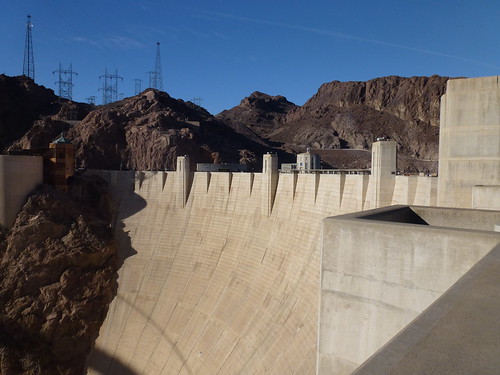 |
| The Hoover Dam straddles the Nevada-Arizona border |
Times and Las Vegas have certainly changed, but we
haven’t. While we are still not gamblers,
we’ve succumbed to Las Vegas ’ fascinating
allure. But I digress.
This post is really about Las Vegas
as a gateway to the fascinating Hoover Dam, a place that has been on our hit
list but which we somehow never managed to visit—until this trip.
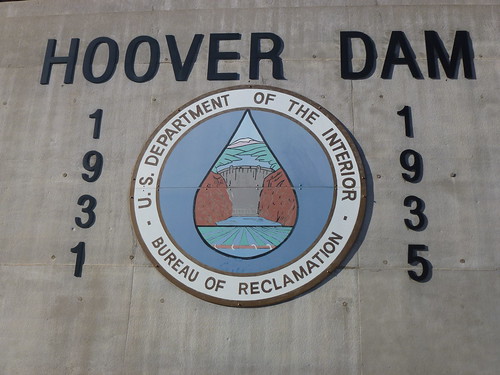 |
| Take note of the years |
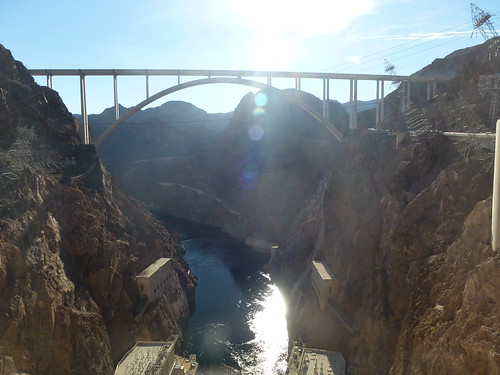 |
| The dam is 726 feet high It is 1244 feet long At the top it is 45 feet thick |
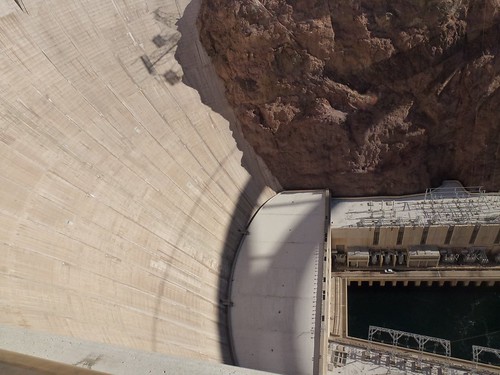 |
| Look down from the top, and you will gasp just a bit. |
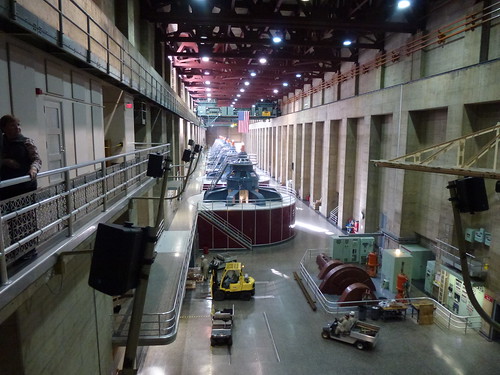 |
| Does this "room" which houses the turbines look small as you watch from above? |
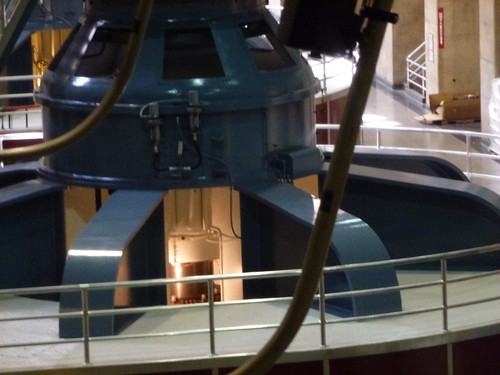 |
| Here is a little bit of a close-up. These are HUGE. |
Imagine the political upheaval. The mighty Colorado
runs through seven western states into Mexico ,
and each state has its own priorities and problems. Within each state are two factions: urban and
rural. Each faction has its own
priorities and problems. Before anything
can be done, the federal government has to improve and furnish funds. There is also the conflict between money
intended solely for the west without consideration of the eastern part of the
country. Political progress is
snail-crawling slow. It takes years before Herbert Hoover, well
before his presidency, can negotiate the Colorado River Compact to make the
dam a possibility.
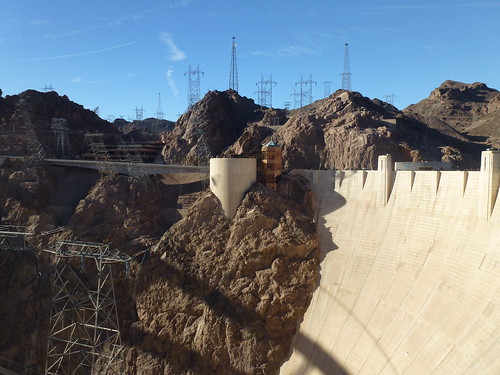 |
| Hydroelectric energy sent out to power the states. |
More than 200 engineers helped design the dam that was first
proposed in 1922 and approved through the Boulder Canyon Project Act in 1928. By that time it was Herbert Hoover,
president, who signed the Act into law.
Imagine the workforce problems. The site, Black
Canyon Arizona ,
Nevada border, is in the middle
of a desert. Yet men and their families,
ailing from the early part of the depression, heard about the job possibilities
and ventured lock, stock, and barrel out to the blistering desert where there
was no housing or facilities ready for them, only the hope that there was a
job. Many lived in tents. Some did not
have even that. Work did not begin until
a year after word of the project went out, but the men wanted to work, and they
camped out and suffered until construction commenced in 1930. Sometimes the temperatures rose to a
blistering 130°.
Over 21,000 men worked on the dam, about 5,000 at any given
time, in three shifts a day round the clock.
Men worked seven days a week, fired if they refused. Two days off a year, Christmas and July 4th,
optional and without pay. It is
estimated that 107 men lost their lives on the project which was miraculously
finished in record time. There were
work-related issues, a strike, oftentimes a carelessness toward worker safety
and health, but most issues were cast aside to complete the project.
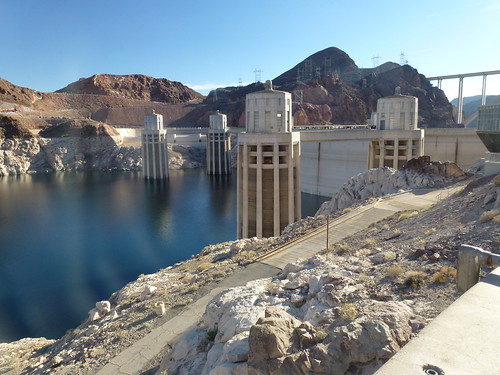 |
| After serving its purpose, the water is released on the other side of the dam. |
Imagine this miracle: the Colorado River
was diverted on Nov. 14, 1932
and the last concrete was poured on May
29, 1935 . President Franklin
D. Roosevelt dedicated it (then known as the Boulder Dam) on Sept. 30, 1935 . The time span is a miracle! Just think of public works’ progress in your
area today!
And public works the Hoover Dam was. This was man’s attempt to harness a wild,
untamed river, the Grand Canyon carver—the mighty Colorado
River . Harness its power
and floods plaguing one section might be stopped and allow agriculture to
flourish. Harness its power and the
desert could be watered into cooperation with agriculture and human life.
Had the dam been built by pouring concrete the conventional
way, the concrete would have taken 125 years to cure. New techniques had to be developed.
There are a host of engineering and architectural developments as
by-products of the dam’s construction.
When the gracefully arched dam was finished and the water
poured in to the area beyond, Lake Mead was formed—115
miles long and 500 feet deep. This is in
the middle of the desert!
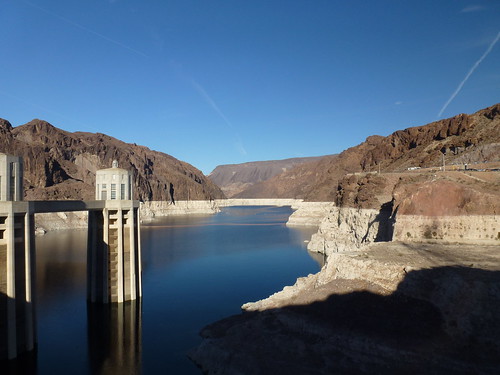 |
| Notice the white "border." Only once in its history were the spillways opened. That was in 1980. The water level was so high that it left its watermark as it receded. I think it adds even more beauty to the scene. Don't you agree? |
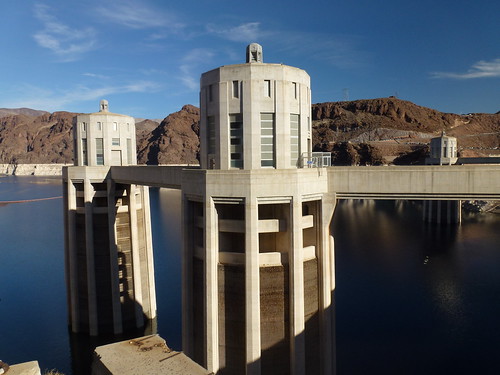
The Hoover Dam is also beautiful. Its design is futuristic in an art deco
style. In the engine room where 17
turbines generate two billion watts of electricity, the floors are terrazzo
marble in designs reminiscent of Native American patterns. The dam is
magnificent, inside and out. There is even a celestial map marking the exact
position of the stars on the day President Roosevelt dedicated the dam.
 |
| Priceless by today's standards. Impossible to use terrazzo marble today. |
 |
| You can also see how huge these designs are. Quite magnificent. |
 |
| Beautiful |
Friday, May 02, 2014
BLUEBIRD, BLUEBIRD THROUGH MY WINDOW....
 |
| The bluebird is New York State's official bird. Its population dwindled as attacks by English house sparrows chased them from their nesting sites. Over the last years, New Yorks busily installed bluebird houses on their properties. The result of the concerted effort, according to an article in our local paper, The Times Herald Record, touts the bluebird's resurgence thanks to houses like this--one of several in our back yard. Nice to read. Wonderful to see. A sight to enjoy. (Are you old enough to remember the elementary school song that is the title of this post?) |
Wednesday, April 30, 2014
UNBROKEN: BE INSPIRED BY THIS TRUE STORY OF RESILIENCE

For a horrifying but very real picture of human resistance
and endurance in time of war, read Laura Hillenbrand's captivatingly written
Unbroken. This is non-fiction that reads
as fiction. Make sure you have time because once you pick up this book, you
will not want o put it down.
Hillenbrand is extremely careful to let us get to know our
protagonist, Louis Zamperini, from the time he was a child, an often
recalcitrant child, until he was captured and held as a prisoner of war by
the Japanese during World War II. The
author's meticulous depiction of Louis'
background, his focused attempt to become an Olympic runner in the famous 1936 Olympics and later as a dedicated Army Air Corps bombardier helps us understand how Louis, despite the odds, withstood the
Japanese treatment of prisoners of war and particularly of him.
In June, 1943, Zamperini and his fellow fliers were shot down and adrift
in an ocean teeming with sharks. They
had just enough food to sustain the barest of life for those not injured; they
managed just enough water to do the same, and then, after being strafed by a
Japanese fighter, they were captured and became part of the Japanese
prisoner-of-war system that left more dead prisoners by a significant margin
than any other country in WWII. The
Japanese culture despised the idea of surrender or of being captured by the
enemy, and their treatment of their captives reflected their disgust and lack
of respect.
It's easier to understand the treatment of prisoners when one reads what Japanese politician Nakajima Chikuhei said in 1940 “...it is
the sacred duty of the leading race [Japanese] to lead and enlighten the inferior
ones.” The Japanese, he continued are the “sole superior race of the world.”
Its military-run school system drilled children on this imperial destiny.”
Because of their schooling, violence became an integral component of the Japanese military culture: “...the Japanese imperial army made violence a
cultural imperative.” Before America was
attacked at Pearl Harbor, Nanking was an example of the Japanese approach. Needless to say, Japan's prisoner of war camps
were violent places that resulted in more deaths than in releases at the end of
the war.
Throughout Unbroken, Laura Hillenbrand leads her readers to
understand not only the Japanese approach to its prisoners and supports her statements with statistics but also to see how Louis Zamperini had grown into a man who had a
chance of surviving despite the odds.
I absolutely do not want to give you any more specifics
about what Louis endured nor do I want to delve too deeply into his “before”
and “after” lives. All of this man's
life was a remarkable journey.
Why read it if it is simply the biography of a splendid individual? The answer is simple. Louis has a a great deal to teach us about
dedication, endurance, and finding one's self time and again despite the pain. His life is something we can all profit from
understanding.
Unbroken is well-written, interesting, supported (you will
see her bibliography at the end), and will make you want to look at other
books by Laura Hillenbrand.
Unbroken is going to be the book read in this fall's Orange [County] Reads program, and I will be leading the discussion in several libraries around the county. If you live here, I hope you'll participate.
Friday, April 18, 2014
FRIDAY'S FOTOS FROM JERUSALEM
 |
| This is the Roman Catholic Church of All Nations or the Church or Basilica of Agony It is located at the foot of The Mount of Olives in Jerusalem next to the Garden of Gethsemane The Church enshrines a section of stone from the Garden of Gethsemane where it is believed Jesus prayed on the night of his arrest. |
.JPG) |
| Higher up on The Mount of Olives and gleaming in the sun is the Russian Orthodox Church of Mary Magdalene. It is arguably one of the most beautiful churches in Jerusalem. |
Subscribe to:
Posts (Atom)