 |
| The bluebird is New York State's official bird. Its population dwindled as attacks by English house sparrows chased them from their nesting sites. Over the last years, New Yorks busily installed bluebird houses on their properties. The result of the concerted effort, according to an article in our local paper, The Times Herald Record, touts the bluebird's resurgence thanks to houses like this--one of several in our back yard. Nice to read. Wonderful to see. A sight to enjoy. (Are you old enough to remember the elementary school song that is the title of this post?) |
Friday, May 02, 2014
BLUEBIRD, BLUEBIRD THROUGH MY WINDOW....

Wednesday, April 30, 2014
UNBROKEN: BE INSPIRED BY THIS TRUE STORY OF RESILIENCE

For a horrifying but very real picture of human resistance
and endurance in time of war, read Laura Hillenbrand's captivatingly written
Unbroken. This is non-fiction that reads
as fiction. Make sure you have time because once you pick up this book, you
will not want o put it down.
Hillenbrand is extremely careful to let us get to know our
protagonist, Louis Zamperini, from the time he was a child, an often
recalcitrant child, until he was captured and held as a prisoner of war by
the Japanese during World War II. The
author's meticulous depiction of Louis'
background, his focused attempt to become an Olympic runner in the famous 1936 Olympics and later as a dedicated Army Air Corps bombardier helps us understand how Louis, despite the odds, withstood the
Japanese treatment of prisoners of war and particularly of him.
In June, 1943, Zamperini and his fellow fliers were shot down and adrift
in an ocean teeming with sharks. They
had just enough food to sustain the barest of life for those not injured; they
managed just enough water to do the same, and then, after being strafed by a
Japanese fighter, they were captured and became part of the Japanese
prisoner-of-war system that left more dead prisoners by a significant margin
than any other country in WWII. The
Japanese culture despised the idea of surrender or of being captured by the
enemy, and their treatment of their captives reflected their disgust and lack
of respect.
It's easier to understand the treatment of prisoners when one reads what Japanese politician Nakajima Chikuhei said in 1940 “...it is
the sacred duty of the leading race [Japanese] to lead and enlighten the inferior
ones.” The Japanese, he continued are the “sole superior race of the world.”
Its military-run school system drilled children on this imperial destiny.”
Because of their schooling, violence became an integral component of the Japanese military culture: “...the Japanese imperial army made violence a
cultural imperative.” Before America was
attacked at Pearl Harbor, Nanking was an example of the Japanese approach. Needless to say, Japan's prisoner of war camps
were violent places that resulted in more deaths than in releases at the end of
the war.
Throughout Unbroken, Laura Hillenbrand leads her readers to
understand not only the Japanese approach to its prisoners and supports her statements with statistics but also to see how Louis Zamperini had grown into a man who had a
chance of surviving despite the odds.
I absolutely do not want to give you any more specifics
about what Louis endured nor do I want to delve too deeply into his “before”
and “after” lives. All of this man's
life was a remarkable journey.
Why read it if it is simply the biography of a splendid individual? The answer is simple. Louis has a a great deal to teach us about
dedication, endurance, and finding one's self time and again despite the pain. His life is something we can all profit from
understanding.
Unbroken is well-written, interesting, supported (you will
see her bibliography at the end), and will make you want to look at other
books by Laura Hillenbrand.
Unbroken is going to be the book read in this fall's Orange [County] Reads program, and I will be leading the discussion in several libraries around the county. If you live here, I hope you'll participate.
Friday, April 18, 2014
FRIDAY'S FOTOS FROM JERUSALEM
 |
| This is the Roman Catholic Church of All Nations or the Church or Basilica of Agony It is located at the foot of The Mount of Olives in Jerusalem next to the Garden of Gethsemane The Church enshrines a section of stone from the Garden of Gethsemane where it is believed Jesus prayed on the night of his arrest. |
.JPG) |
| Higher up on The Mount of Olives and gleaming in the sun is the Russian Orthodox Church of Mary Magdalene. It is arguably one of the most beautiful churches in Jerusalem. |
Thursday, April 17, 2014
A SPECIAL HOUSE OF WORSHIP IN SAVANNAH, GEORGIA
 |
| Congregation Mickve Israel Savannah, Georgia |
As we travel, we often stop to admire beautiful houses of worship, especially those known for their unique characters. We visited one of these special places in Savannah, Georgia.
It seems fitting that as Jewish peoples around the world are
in the midst of the holiday of Passover, a holiday celebrating the liberation
of a people from slavery, I write about a more modern and early group of
Georgian settlers leaving one land searching for freedom of religion in another.
The third oldest Jewish community in America is located in
Savannah, Georgia where, on July 11, 1733, just five months after James
Oglethorpe established the colony of Georgia, a group of 34 poor Sephardic Jews
(of Spanish/Portugese heritage who had been Crypto-Jews, publicly practicing
Catholicism while secretly retaining their Jewish identity and religion) and
eight Ashkenazic Jews (of German descent) arrived from London to begin a new
life.
They brought with them a Torah (Bible) made of deerskin. That Torah is still used today on commemorative occasions, and those Jewish immigrants established a synagogue, Kahal Kodesh MickvaIsrael —Holy
Congregation Hope of Israel. They came
looking for religious freedom and a new life, and even today, descendents of
those original Jewish settlers participate in this synagogue and this
congregation.
They brought with them a Torah (Bible) made of deerskin. That Torah is still used today on commemorative occasions, and those Jewish immigrants established a synagogue, Kahal Kodesh Mickva
This was the largest single immigration of Jewish people to
this continent . Their specific purpose
was to establish a Jewish congregation and to practice their religion freely.
Why did I choose to include this synagogue still functioning
today in a city where the Jewish population is about 3,700 people? When George Washington was elected the first
President of the United States ,
the president of this synagogue wrote him a congratulatory letter. George Washington, President, replied thusly:
 |
| Letters from ten United States' Presidents beginning with George Washington |
May the same wonder-working Deity, who long since delivered the
Hebrews from their Egyptian oppressors, planted them in the promised land,
whose providential agency has lately been conspicuous in establishing
these United States as an independent nation, still continue to water them
with the dews of Heaven, and make the inhabitants of every denomination partake
in the temporal and spiritual blessings of that people, whose God is
Jehova”
Today in the
synagogue’s archival museum are letters from ten presidents including James
Madison, Thomas Jefferson, Bill Clinton, and George Bush.
In a way the history
of the Mikva Israel Synagogue in Savannah , Georgia Egypt
If you get to Savannah
Take the tour of the building, and see a beautiful part ofSavannah
Take the tour of the building, and see a beautiful part of
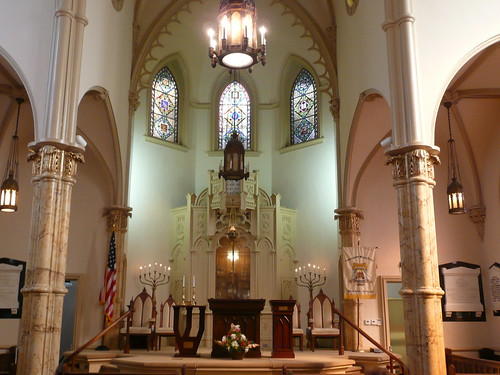 |
| The "walls" of the Ark holding the Torah represents the walls of Jerusalem |
Saturday, April 12, 2014
FRIDAY'S FOTO
 |
| Nice weather has FINALLY arrived and makes me think of golf. Here's the view from our balcony on the Big Island of Hawaii. Those track-like marks in the background are lava flow scars. |
Subscribe to:
Posts (Atom)