Search This Blog

A Bit More

Thursday, October 30, 2008

COSTA RICA--PART 2

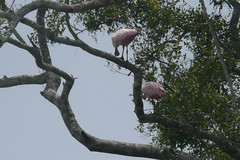
What a beautiful country is Costa Rica. We thought it wasn’t going to get any better than the fantastic voyage on the Tarcoles River, but we were wrong. We were slated for another incredible voyage, but this time through the air. We rode a gondola up through the thick jungle greenery through the canopy, all the time delighting in the abundantly lush foliage including ferns, lianas, orchids, and astoundingly different trees. There were huge termite hives nestled in the crotches of some trees. Absolutely awesome! The naturalist-guide spoke throughout, naming some of the species or pointing out animals and birds or their nests. It was incredibly beautiful. We watched some zipliners go down through the canopy, and I think I would love to try that. Well, maybe.
We also toured the botanical gardens at the base of the tram. The gardens contained flowers so beautifully and vibrantly colored that we wanted to touch them to make sure they were real. Our guide, however, warned us that often miniscule but potentially lethal snakes crawl into the flower’s recessed parts and touching the flower might cause a very unfavorable ending to the day. We heeded the warning!

There, too, we enjoyed a Costa Rican lunch—fresh fruits, including ripe and juicy papaya and wonderful bananas—the kinds we can never get in stores--chicken, rice, and beans among other things. We also had the opportunity to taste Costa Rican coffee which was so good that we bought several bags to bring home.

We are interested in returning to this very intriguingly beautiful country. We did not get a chance, of course, to see the Caribbean side or the resorts and beaches. There’s so much more to see and do here.

I have to tell you that Costa Rica has a serious garbage problem. There is garbage everywhere—in the streets as well as in and along the rivers. It was so evident that our guide felt he had to talk about it. Randall explained how the government is trying to deal with the problem and has a television advertising campaign to educate people about garbage disposal even as the government works on pickup problems, etc. It’s a cruel irony to see a country so ecologically involved yet struggling with a garbage problem. The crocodiles we saw, for instance, live among old tires and bottles thrown by the river up on the muddy banks. Again, I am only talking about the areas we saw. As Third Age Traveler is more than just a “travel diary,” in good conscience I must mention that. I also say that the problem would not keep us from returning.

"travel+blogs" "third+age" "third+age+traveler" "Costa+Rica" "Tarcoles+River" "Central+America" "rain+forest" "botanical+gardens" "travel+diary"

THE GRAPES OF WRATH


My friend, Carol, is a great re-reader, something I do rarely. But my recent re-reading of Steinbeck's monumental 1939 novel, The Grapes of Wrath, moved me in ways I never expected. Almost 70 years after its initial publication, The Grapes of Wrath remains contemporary, politically astute, and skillfully artistic. If anything, the passage of time and the way history provided the finishing touches to the story increases its already inestimable value.

This is a sad story. Nature, economics, greed, and human nature run amuck, and the result is incredible human misery. This is an uplifting story. Moral courage, perseverance, a set of values, and an understanding of how human beings can lead purposeful, good, compassionate lives result in the belief of the strength of the human spirit.

Steinbeck pulls out the stops. His novel is the narrative of people forced from their land to wander and readjust to a new world that is cruel, destructive, and uncaring. At times it might seem a bit preachy, but most of the narrative is moving and descriptive. A reader is drawn into the action and longs to see how each character reacts to his life's circumstances.

As a writer, Steinbeck pulls out all the stops literarily. You don't need to recognize his art to feel the power of the novel, but his allusions are fun to discover--like pieces of a puzzle. You might miss Steinbeck's art altogether because his skill makes everything blend seamlessly, but he does employ all the literary techniques that add depth and meaning to his work--should that be what you're looking for. My favorites here included the intercalary chapters--those chapters not about the Joad family but about "all people," the words of the characters that hint of bigger meanings as when Ma Joad informs Tom, "...we're the people..." perhaps as a reminder to insensitive government of the words of the Declaration of Independence, of the unmistakable use of symbols and analogies to other stories like the Exodus and the Myth of the American West. Don't be put off by any of this. Grapes of Wrath is an eminently readable book. It’s a great and moving story.

Take Grapes of Wrath away with you on a trip. It will involve you, delight you, horrify you, offend you, and make you pause to consider what your mind's eye is seeing. And when you're done, rent the 1940 (imagine--book to movie in less than a year) John Ford movie starring Henry Fonda as Tom Joad. You won't be sorry!

"Third+Age" "Third+Age+Traveler" "travel+blogs" "Grapes+of+Wrath" "book+reviews" "travel+books" "Henry+Fonda"

TRAVEL TIPS

We just got back from a trip to Charleston for our nephew's wedding on the gorgeous Isle of Palms--our third stay in Charleston but there is still more to enjoy there. Conde Nast Traveler magazine's Reader's Choice Awards gave Charleston the #2 spolt as the best U.S. cities to visit. Took that place away by bumping NYC to #3!
"travel+tips" "third+age+travel" "third+age+traveler" "South+Carolina" "Isle+of+Palms" "New+York+City" "Conde+Nast"

Friday, September 19, 2008

AWESOME TRAVELS THROUGH THE PANAMA CANAL

Cruising the Panama Canal is an absolute must! Here’s a perfect example of an engineering marvel and the extraordinary result of man’s persistence in overcoming monumental challenges. Charles I of Spain first proposed a canal through the Isthmus of Panama in 1534. Three centuries passed before it was attempted, and it was not until 1914 that the Panama Canal was completed at a cost of $387 million dollars. With this information in mind as we traveled through the locks we kept its wonders in perspective and felt it imperative to observe every phase of the operation.

In the evening prior to entering The Panama Canal, PBS documentaries and other information were available in our stateroom so we might truly appreciate experiencing this engineering marvel. The information was extremely helpful as the canal’s history and building is fraught with disease, disaster, international ramifications, and more than 27,000 deaths before ultimate triumph. Movie clips and photographs amply illustrate the dynamic scope of this undertaking, and the visuals are stunning. To truly appreciate the Panama Canal, it is necessary to forget that it is the 21st century and to imagine it is 100 years ago. With the photographs, that is easy to do.

The toll for our ship, the Coral Princess, to navigate the locks is a whopping $245,600. In addition to factoring in her net tonnage, Princess Cruise Lines pays the premium toll so her passengers get to experience the entire crossing. We begin early in the morning for the seven hour experience, and we can observe everything that happens. The lowest toll ever paid, by the way, was 36¢ paid in 1928 for a swim-through. Most ships average $35,000 based on net tonnage.
Sometime in the night, the crew prepared seating on the bow of the ship, and during the voyage cruisers who really got up early so as not to miss anything were generous in sharing their view. They made sure that those in the rear were able to go up to the front and take photos. Those taking pictures did so quickly and then cleared the improvised aisle for the next person. It was a wonderful and, sadly, unusual experience to have such consideration. It’s a shame I find it so unusual I am commenting on it. Anyway, the canal pilots board the Coral Princess around 5:15 AM as we approach the first set of locks, the Gatun locks. We are connected to eight “mules,” diesel-electric locomotives that guide us through and keep the ship centered.

As you can see in the photos, there is virtually no wiggle room here, and as ships get bigger, there’s talk of adding new, wider locks. Once through the lock, the mules release and we move on.

One view that really added to our amazement and perspective was watching a cargo ship move in the other direction. Many of the crew lounged on deck waving to us, but we could clearly see the water levels change and the ship smoothly readjust to the next level.

It was also intriguing to move to the stern and view the ships coming into the locks behind us, and, in fact, the line of ships waiting to enter. In 2005, more than 14,000 ships made this crossing, most of them commercial vessels. Many of the ships wait in line just as we might at a crowded Thruway tollbooth.

We crossed Gatun Lake, which at the time it was built between 1907 and 1913 was the largest man-made lake in the world. Rain filters down from Panama’s rain forests to fill the lake. The water is used in the locks and then flows out to the oceans.

After navigating Gatun Lake, we re-attach to mules at the single lock at Pedro Miguel, and later to the Miraflores Locks where we are lowered, in two stages, to sea level on the Pacific Ocean side. We are guided by tugboat toward the Bridge of Americas and then out to the Gulf of Panama.

A trip through the Canal is 6,000 miles from New York to San Francisco, less than half the 14,000 miles traveling the old way all the way to the tip of South America and rounding the treacherous Cape Horn. As expensive as the tolls seen, think of today’s oil crisis. Had the Canal not been built, think how much more expensive many of the goods carried by the cargo container ships might be.

There are many good books about the Canal, one by David McCullough which is now on my “to read” list, and some good documentaries, including the PBS presentation. Traveling through the Panama Canal is a bit like traveling through history. I highly recommend this excursion.


"Panama+Canal" "Central+America" "Gatun+Lake" "Bridge+of+the+Americas" "South+America" "Cape+Horn" "senior+travel" "third+age" "Third+Age+Traveler"

Wednesday, September 17, 2008

Mark Twain's House

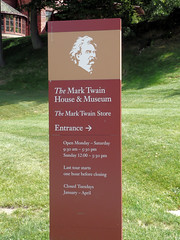
All modern American literature comes from one book by Mark Twain called Huckleberry Finn. Ernest Hemingway, no slouch of a writer himself, said this, and the thoughtful reader of Mark Twain sees his greatness. Why not visit his home for the opportunity to gain more insight? Carol and Anne were up for it, so on a lovely Aug. day, we took a ride to Hartford, CT and Mark Twain’s home at Nook Farm.

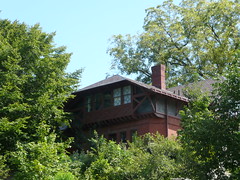
Twain’s home is conveniently located just a few blocks off the I 84, and there are signs on the highway and on the city blocks to direct drivers to the parking lot. In Twain’s day, the home was in the country, removed from Hartford, the most prosperous city in America at the time. Things have changed, however, and even the river that ran through the property is now underground. Still, the view from the famous porch that appears in any movie or documentary (Ken Burns’ for PBS, for instance) or from the glass sunroom or from the third floor billiard room allows us to imagine the verdant scenes Twain enjoyed.

We arrived just in time to book two tours of the home, one leaving almost immediately—the 45 minute Servant’s Wing ($3.00) and the hour long House Tour ($14.00).

Twain’s simple instruction to his architect was to build a red house. And that’s exactly what he got. His architect had primarily designed churches, and Twain’s house shows many “churchy” touches. It’s dark and heavy inside—allowing Twain to skimp on the interior, finding ways to “suggest” more expensive decorations than he could afford. For instance, he hired Louis Comfort Tiffany’s design company for the interior, but the stenciled wall designs are paint rather than the mother of pearl they suggest.


On the Servants’ Wing tour we learned that Twain had several long-time servants. The most important was George Griffin, his butler. Some suggest that George is the basis of Jim, the runaway slave who becomes a wise, father figure to Huck. At any rate, though married and with his own home in Hartford, Griffin maintained a room in the Twain household and was with Twain for 18 years. His butler’s pantry is spectacular, and his management of the household affairs led him to become Twain’s friend and confidant. Twain wrote of Griffin and a visit they took to New York City.

"A white man and a negro walking together was a new spectacle to them. The glance embarrassed George but not me, for the companionship was proper; in some ways, he was my equal, in some others my superior; and besides, deep down in my interior I know that the difference between any two of those poor, transient things called human beings was but microscopic, trivial, a mere difference between worms."

Another long-time servant, Kate Leary, wrote a book about her 30 year tenure with the Clemens family, and that’s another addition to my “to read” list. Should be interesting.

There were quick turnovers for most of the Clemens’ servants. Sam and Livy were party people and threw dinner parties frequently with elaborate menus requiring long hard hours for their staff. George stayed overnight on those occasions, but the kitchen staff just tired! On the House Tour we saw the dining room with its faux leather wall paper (the Clemens could not afford the real leather wall paper popular in their day) where the parties and conversations occurred. Then the women withdrew to the drawing room, and Twain and his cronies puffed cigars and talked in his library—Twain is reputed to have smoked 20 per day—or drank and played billiards on the third floor—he was such an avid billiard player that his writing desk in that room was angled so he would not look at the table and be lured from his work.

We loved looking at the titles in the Clemens’ library—beautifully bound classics from America and England, books in foreign languages, etc. Books that made us smile. His personal copies are kept in a separate library maintained for scholars and available by appointment. He was a voracious reader, but he was also a margin writer, commenting, applauding or criticizing in the margins! Those books are too valuable to leave on public shelves. He never wrote a negative comment in Harriet Beecher Stowe’s books; they were neighbors. He did not enjoy Jane Austen, however, and those margins are filled with negative and sometimes awful comments. I’d like to go back and browse through those books.

The library has an ornately carved wooden fireplace mantle and wall complete with coat of arms. Not Clemens’ coat of arms. Clemens visited a Scottish castle, saw the fireplace and bought it. When he got it home, it was too tall for the room. The top section was removed and placed above the doorway to the dining room. Voilá.

Are you beginning to see the eccentricities inherent in Sam Clemens and his home?

Upstairs is the master bedroom and a most unusual bed. The Clemens family bought it in Venice. It was reputed to be a valuable antique, and they paid a handsome sum for it. Turned out it was not an antique and Clemens had been swindled! He and Livy used the bed anyway, but they slept against the footboard. He explained that since he had paid so much for the bed, he might as well be able to look at the carvings on that ornate headboard and enjoy them!!!! The children were able to take off and play with the wooden cherubs on the bedposts as long as they replaced them after the game.

We had a wonderful guide, Matt, whose enthusiastically animated presentation of Sam Clemens as a man rather than as an icon made this trip even more worthwhile.

We had lunch in the Museum’s café, and I recommend that as well as their expansive gift shop filled with Twainabilia (is there such a word?). I picked out some items including a Mark Twain for President bumper sticker with his picture and this quote: “It’s better to be popular than right.”